Books & literature
Woodstock Literature Society: From Oxford to Narnia
Review of a talk on Wednesday 20 May 2026
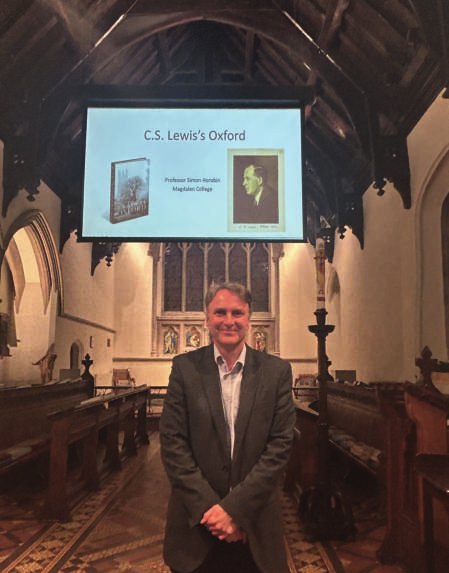
By Professor Simon Horobin From Oxford to Narnia: the Worlds of C.S.Lewis
Following our summer party in May, we enjoyed a fascinating talk by Professor Simon Horobin on C.S. Lewis. As a Fellow of Magdalen College, he has a keen interest in Lewis, who was a Fellow of the same College.
Professor Simon Horobin Lewis was born in Belfast, arriving in Oxford in 1917, where his studies in 'Greats' (Classics) were soon interrupted by being called to serve in the closing stages of the war. Returning to Oxford, he gained a double first, and it was clear that he would pursue an academic career, which he achieved by taking a degree in the newly established School of English and becoming a Fellow at Magdalen College, where he remained for the next 30 years.
Lewis’ sitting room at Magdalen, overlooking the deer park, became a hub for lively discussion, sometimes with undergraduates in tutorials - although he found students like John Betjeman irritatingly idle! - but also in long evening sessions with fellow academics. He joined and set up several societies which met at Magdalen and elsewhere, where in addition to debate members would share chapters from their current writings.
The most famous of these clubs, of course, was the wittily titled Inklings, who met at the Eagle and Child pub in St Giles weekly to share their current work. Lewis was by this time a close friend of J.R.R. Tolkien, and it was in this setting, wreathed in pipe smoke and beer mugs in hand, that new chapters from The Hobbit and The Narnia Chronicles were shared and discussed.
What is extraordinary is how a highly educated academic with no children of his own came to write children’s fantasy fiction. One answer, of course, is that the Narnia books are Christian allegories, and Lewis was a devout Christian convert who wrote many books exploring faith, such as The Screwtape Letters. Professor Horobin also pointed out that Tolkien and Lewis shared a passion for early northern European mythology which sat quite comfortably with their Christian faith, with many evil creatures from these early texts finding their way into their fantasy tales.
Perhaps the real answer is that Lewis, with his eccentricities and passionate enthusiasms, remained fundamentally a child at heart? He was also a kind and thoughtful man: during WW2 he corresponded with a former student interred in a prison camp, sending him an ambitious reading list which he imagined the prisoner could access! A wonderful mixture of the humane and the other-worldly.
If you’d like to find out more, Professor Horobin’s book C.S. Lewis’s Oxford is recommended.