Books & literature
Woodstock Literature Society: W. H. Auden - Early and Late
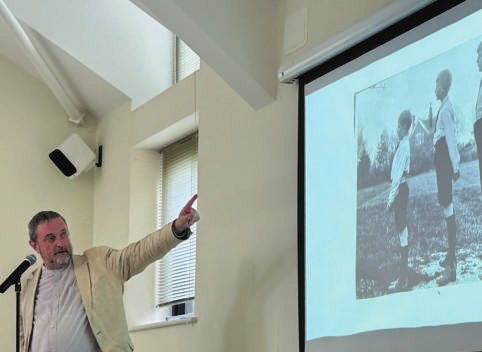
Review of a talk on Tuesday 16 June 2026 by Professor Seamus Perry
“W.H.Auden: Early and Late”
We were delighted to welcome back our Woodstock neighbour Professor Seamus Perry, soon to be installed as Master of Balliol, this time to talk about the development of W.H.Auden’s thinking and poetry.
Professor Perry pointing out Auden, the youngest of three brothers.
Professor Perry has a particular interest in political poetry, and certainly the younger Auden’s work was very much influenced by the rise of Fascism in the 1930’s. He had earlier been drawn to T.S. Eliot’s depiction of the moral wasteland following the first World War, and he shared the leftwing views of Oxford friends like Stephen Spender, Christopher Isherwood and Louis Macniece. After his experience in Spain during the Civil War, he wrote Spain, partly to raise funds for medical relief work in that country, but later came to despise the easy rhetoric of this early work. Indeed, Auden was in the habit of adding derogatory comments about his work when signing copies for fans.
Musee des Beaux Arts, one of his most famous poems, took a more nuanced view of human experience, noting how humdrum human life continues regardless as Icarus falls into the sea in Breughel’s famous painting. And in his later poem The Shield of Achilles, Auden rejects all ideas of the nobility of warfare; in place of “ritual pieties” following war, the true horror of mankind’s capacity for cruelty is depicted. Declared unfit for military service, Auden left Europe for the United States in 1939, and later took US citizenship, saying that he chose to live there because it was a rootless country.
Auden was a complex and fascinating man, and his oeuvre is equally vast and varied, but this talk gave us an insightful glimpse into the subject. Professor Perry is currently writing a biography of Auden, and provided us with some surprising snippets: for instance, as a young man, Auden was fascinated by science and engineering, and in fact began studying Natural Sciences at Oxford before switching to the new subject of English Language and Literature. It was also interesting to be introduced to a late poem called Moon Landing, an enterprise he concludes “would not have occurred to women/ To think worthwhile”.
We are fortunate to have recordings of Auden reading some of his own poetry, and you could hear a pin drop as the audience listened to the poet reading some of his own work. Many thanks to Professor Perry for sharing some of his extensive knowledge of Auden, whom he sees as the foremost English poet of the 20th century, in such a stimulating talk. We look forward very much to reading Professor Perry’s biography of Auden.