Books & literature
Woodstock Literary Connections: Michael Place
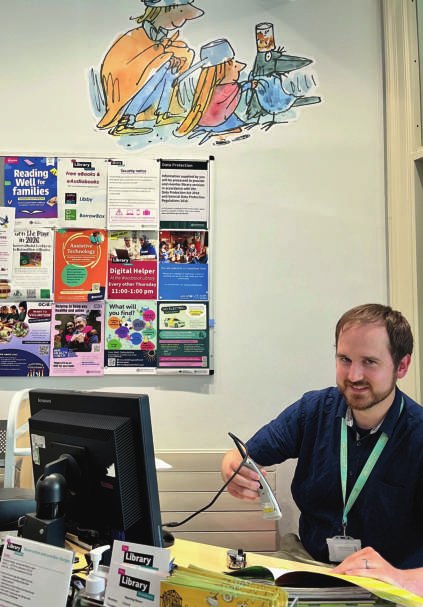
Michael Place, Librarian in Woodstock
Interviewed in Woodstock by Judd Flogdell
Michael Place, Woodstock Librarian
Whilst in the library recently, to collect a book I’d reserved, I thought it would be great to interview our friendly and efficient librarian, Michael Place (whose official title is Peripatetic Customer Service Adviser).
JF: To begin with, tell us a little about yourself; where you’re from and your background?
MP: I’m from Manhattan in Kansas, and studied secondary education at University there. After that I moved to study Ancient History, Archaeology and Museum Studies at the University of Leicester. Following on from that I progressed into working with library collections.
JF:
For how long, and how did you come to be working in Woodstock Library?
MP: My wife found new employment with the University, and as a result we have been here in Oxfordshire for almost five years, when I started working for Oxfordshire Library Services. That includes time spent in Woodstock, Bicester, Cowley, and Oxford Westgate Libraries.
JF: Tell us about a favourite book or books from your schooldays?
MP: In my early schooldays my favourites were William Golding’s Lord of the Flies, and Orwell’s 1984. At university, reading De Officiis by Cicero, and Marcus Aurelius’ Meditations helped greatly to shape who I am. Here in the UK, I love to read everything by Terry Pratchett.
JF: What changes have been introduced in our library, or libraries during your time?
MP: We, as a service, have been making a concerted effort to have meaningful conversations with people to improve the physical and mental well-being of people in Oxfordshire.
Also, we will be adapting The Reading Agency’s Summer Reading Challenge, an annual, nationwide library scheme which will be running slightly differently this year with more opportunities to complete the challenge. It runs between 4th July - 5th September, and the focus, as always, is to get more young people into libraries and reading.
JF: I imagine that the internet has changed our use of reference books, which reference books are most frequently used, and are books such as cookery books still borrowed?
MP: There is a small stock of reference books in Woodstock, but they are stocked across other Oxfordshire libraries too. A reader’s library card entitles them to free access of Encyclopaedia Britannica online and free access to newspapers, magazines, library e-books and audio books. Amongst non-fiction books, cookery books are still popular, as are those about art and crafts, and Social Science.
JF: Could you tell us some facts or stats about the books in Woodstock Library – such as which writers/ novels are most popular?
MP: In the year 2025-26 Woodstock library issued 21,300 books, and around 13,000 visits. Junior fiction are probably the most frequently borrowed type of books. It is not uncommon to have 40 or more names on a waiting reservation list. New books by major writers, such as Richard Osman, can see a reservation list which is up to 150 names long! Overall, Oxfordshire Library Services had 2m visitors to the library, 3.5m loans, and over 19,000 meaningful conversations last year.
JF: What about children’s books and activities for younger readers?
MP: Children’s books are categorised slightly differently, and sorted by type from picture books, board books, early readers, categorised by level of difficulty, graphic books etc, according to age category. Of these, our picture books are absolutely the most popular, but our early readers see a fair amount of use as well.
For activities, Rhyme Time happens every Friday at 10.30am, and Story Time on Tuesdays at 4.00pm. In addition, we have occasional activities during school holidays. Being located inside the Oxfordshire Museum we have the added bonus of activities co-ordinated alongside what they offer.
JF: Which genre or type of books do you enjoy in your leisure time?
MP: I do enjoy a bit of history non-fiction, but most of my reading at present consists of ‘How to…’ and parenting books.
JF: Are you familiar with the 2004 film The Day After Tomorrow, in one part of which, a group of people are stranded in a library, and are forced to burn the books in a fire to keep warm and stay alive? If in that predicament, which book would you save until last?
MP: I would hang onto the SAS Survival Handbook for as long as possible, in order to get out of that situation!