Heritage
SOFO review: The Rise and Fall of the British Army
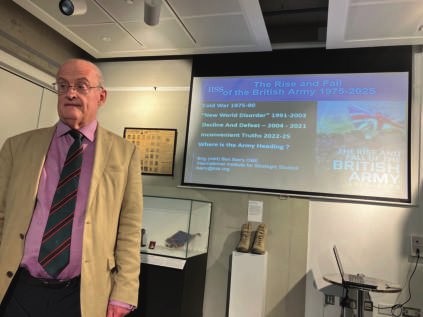
Review of talk by Brigadier Ben Barry, International Institute for Strategic Studies. 'The Rise and Fall of the British Army’ on 13 June 2026
We in Europe currently face a greater threat to our security than at any time since the Second World War. We are at grave risk from Putin’s war in Ukraine and his aggressive intentions towards the Baltic Republics and to the UK and Norway directly, via the High North. Prior to Trump’s second term, Britain and its European NATO allies believed they could rely on the USA and the NATO treaty to keep us safe from Russia. Now, virtually every day, Trump, Vance and Hegseth tell us this is no longer the case, and that we must look to defend ourselves.
This was the context for Ben Barry’s very timely and deeply chilling analysis at SOFO of the current condition of the British army, the subject of his acclaimed new book The Rise and Fall of the British Army. Barry reminded us of stanza 2 of the National Anthem (‘scatter our enemies, frustrate their knavish tricks’) pointing out that it is largely the army's job to scatter our enemies.
The trouble, Barry said, is that with a size of 75,000 and falling, our army cannot do what it did even two generations ago. Then we were able to defend West Germany, keep the peace in Northern Ireland, remove Argentinian troops from the Falklands, intervene to stop the slaughter of Muslims in the former Yugoslavia and protect Sierra Leone. From what Barry called our ‘high water mark’ in 2003, we had moved to a scenario of reduced funding and cuts. By the time of the wars in Iraq and Afghanistan, military planning was already deteriorating thanks to politicians trying to spend the defence budget (‘the peace dividend’) on other things. ‘The old concept of tank battles in Europe’s landmass is over’ Boris Johnson insisted (loudly) as European leaders let Putin take Crimea from Ukraine. Brexiters insisted there would be no more war in Europe. Six years later, in his attempt to obliterate Ukraine, Putin launched that war in Europe.
If we were attacked by Russia today, Barry said, we could fight back for just seven days. In 1990 we could muster 152,000 trained troops. Now, with an army of 75,000 personnel, we could no longer deploy to the front a heavily armed, fully trained brigade (30,000 men), let alone an entire army corps (100,000 men). The Royal Navy, Barry pointed out, was in an even worse condition than the army, with our creaking Vanguard submarines needing constant repair. Yet our intelligence services tell us Putin could decide to attack our Baltic NATO allies within three years (he knows how weak we were).
In Barry’s view, we need to find the necessary cash to defend ourselves whilst understanding that we need a whole new set of defensive weapons, such as drones exploiting AI-led technology.